Have you ever had this feeling?You look at people who seem calm, confident, and naturally expressive.They can speak in front of others, hold conversations with ease, and carry themselves as if they are completely comfortable in their own skin. Then you look at yourself. You feel awkward, tense, and full of self-doubt. Before a presentation, your hands shake. Before trying something new, your mind starts whispering:
“What if I fail?”
“What if they do not like me?”
“What if I am not good enough?”
For a long time, many of us believe confidence is something people are born with. We think it belongs to people who are good-looking, well-spoken, rich, talented, or naturally successful.But later, I realised something important: confidence is not a special gift reserved for a few people, and inferiority is not proof that something is wrong with you.
Most of the time, both inferiority and confidence are simply signals. They reveal how we relate to ourselves, to others, and to uncertainty.
1. The Nature of Inferiority: A Few Truths We Should Understand
Human beings are social creatures. Since ancient times, our survival has depended on belonging to a group. Our ancestors needed tribes to find food, stay safe, and survive harsh environments. Being rejected by the group could once mean facing danger alone.
Even though we now live in modern cities, study in universities, work in offices, and scroll through social media every day, this ancient need has not disappeared. It has only changed form.Today, we still want to be accepted. We want to be liked, recognised, useful, valuable, and needed. On social media, we post photos and wait for likes. In social settings, we want to fit in. At school or work, we want our ideas to be respected. In society, we are often told to get a better degree, earn a higher salary, build a stronger career, and prove that we are “doing well”.
We all care about our own safety, value, and place in the world

Many people rely on external recognition to prove their worth. But once that recognition disappears, fear begins to rise. That fear often appears as overthinking, self-doubt, emotional exhaustion, and inferiority.
Inferiority is often a distorted fear of losing something important to us.
It may be the fear of losing approval, opportunities, respect, connection, or acceptance. This is why inferiority feels so heavy. It is not just about “not feeling good enough”. At a deeper level, it is connected to our fear of being excluded, disliked, or left behind.
Some people may say, “But there really are people who look down on me. My parents criticise me. Some people judge me.” That may be true. But being looked down on by others is not the same as looking down on yourself.
Everyone will experience judgement, rejection, criticism, or misunderstanding at some point.
Nobody can be liked by everyone. The real problem begins when we slowly turn other people’s judgement into our own self-judgement.
When you are talking to someone, you may worry about saying the wrong thing. You may fear that they will dislike you. Deep down, you are not only afraid of an awkward conversation. You are afraid of losing trust,
connection, and acceptance.
Inferiority is often an exaggerated inner drama.
When we feel inferior, it is as if we open a courtroom inside our own mind.One part of us becomes the strict judge. Another part becomes the helpless prisoner.
The judge keeps criticising: “Why are you so useless?” “Why are you so awkward?” “Why can’t you be more confident?” “Why don’t you fit in?” Many of us have heard of the spotlight effect. It means we tend to overestimate how much other people notice us. When we are trapped in inferiority, we often imagine that everyone is watching us, judging us, and remembering every small mistake we make. But most people are busy thinking about themselves. They have their own worries, deadlines, relationships, family problems, and life struggles. Most of the time, we are not standing under a real spotlight. We are holding the spotlight ourselves.

2. The Nature of Confidence: Not “I Am Amazing”, but “I Can Handle This”
Here is a simple example. Imagine two students preparing for a presentation tomorrow.
Student A has not written the script. He has not practised. He has no clear structure and no idea how to handle unexpected situations.
Student B has prepared for several days. She has practised in front of the mirror, adjusted her pauses, planned her gestures, and rehearsed the whole flow. Who do you think will feel more confident? The answer is obvious.
Student A’s anxiety is not necessarily because he is introverted or incapable. It is because he is facing uncertainty without preparation. Student B may still feel nervous, but she has a stronger sense of control.
Confidence is not an overall judgement of your entire identity.
Confidence is your sense of control over a specific situation.
The more familiar you are with something, the more confident you become. The less familiar you are with something, the more uncertainty you feel.And when uncertainty increases, fear often grows with it. This means a lack of confidence does not always mean you are weak.
Sometimes, it simply means you have not yet built enough clarity, preparation, or experience in that area.You may be confident in writing, but not in public speaking. You may be confident with close friends, but not in a new social group. You may be confident at work, but not in dating. That does not make you a “confident person” or an “inferior person”. It makes you human.
Once you understand that confidence is linked to familiarity and control, you can stop treating it as a fixed personality trait. Confidence is not something you either have or do not have. It is something you build.
3. Stop Labelling Yourself: You Are More Than a Personality Type
We love giving ourselves labels:
“I am introverted.”
“I am insecure.”
“I amnot good at relationships.”
“I am not confident.”
“I am not worthy of love.”
Because we do not fully understand ourselves, we often use simple labels to define who we are. These labels may give us a temporary sense of safety, but they can also quietly become a cage.This may also explain why personality tests, horoscopes, and MBTI are so
popular. They give us a shortcut to understanding ourselves. But the danger is that we may start using these labels to limit ourselves instead of exploring ourselves.
The truth is, human beings are complex. Inferiority and confidence are not two completely separate identities. You are not either “an insecure person” or “a confident person”. Both exist inside you.
You may feel inferior in some areas and confident in others. You may feel small in one environment and powerful in another. You may feel uncertaintoday and capable tomorrow.

What matters is the proportion. Some people may feel 80% inferior and 20% confident. Others may feel the opposite. But this proportion is not fixed forever. It can change through experience, reflection, and practice.
A common question is: “How do I know whether I am suitable for something?” You may wonder whether you chose the right major, whether you deserve your current job, whether you are ready for a relationship, or whether people will eventually discover that you are not as capable as they think.
This mindset is especially common among high-achieving people. It is often called imposter syndrome. But this does not mean something is wrong withyou. Sometimes, anxiety appears because your brain is trying to protect you. It wants safety, certainty, and protection from failure. In many cases, that anxiety is also a sign that you are stepping out of your comfort zone. You are growing.
However, if you have tried your best at something and still feel deeply exhausted, it may not mean you are useless. It may simply mean you are in the wrong environment, role, or direction. this is ability misalignment ,it is like asking a fish to climb a tree or asking a bird to swim underwater.
No matter how hard they try, they will only feel pain. Sometimes, that pain is not a sign of failure. It is a signal from your body saying: “Pause. Reconsider. Maybe there is another path.”
So do not rush to define yourself too early. Do not use one failure, one label, one personality test, or one period of confusion to decide who you will be forever. There are still many unknown versions of you waiting to be discovered.
4. Four Ways to Build Deep Confidence
Since confidence and inferiority both exist inside us, the goal is not to completely remove inferiority. That is unrealistic.
The goal is to build a healthier relationship with ourselves, so confidence can gradually take up more space.
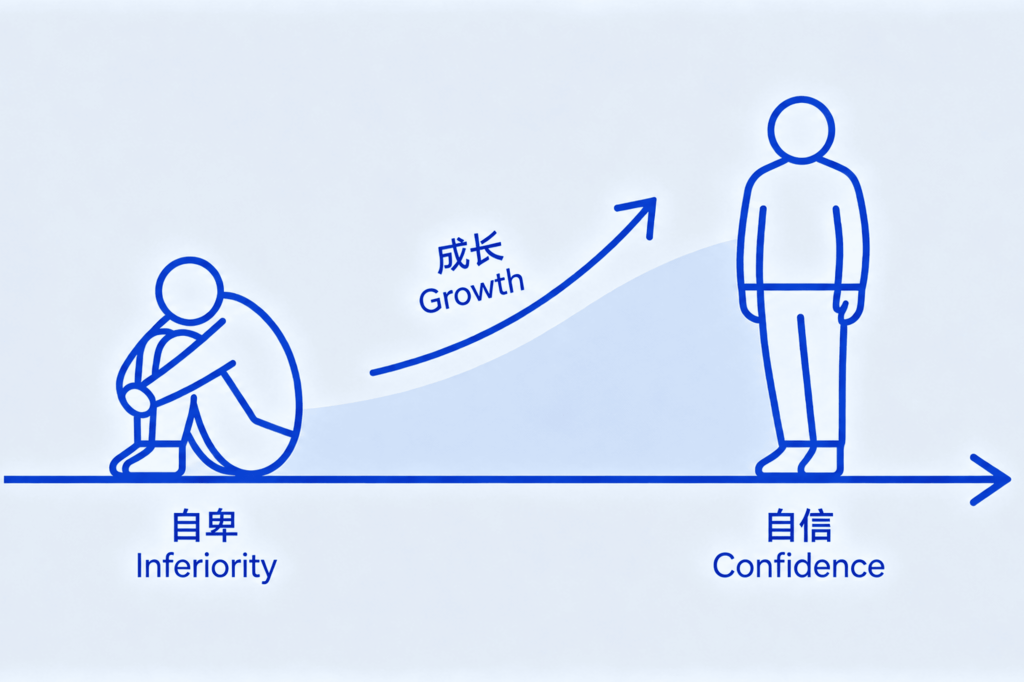
A. Self-Acceptance: Stop Standing Against Yourself
Many of us have a strange habit. When other people make mistakes, we comfort them: “It’s okay.” “Everyone makes mistakes.” “Don’t be too hard on yourself.” But when we make a mistake, we attack ourselves immediately.
It is as if we become our own enemy. But if we understand the nature of inferiority, we can begin to see confidence differently.
Confidence is not the absence of weakness. Confidence is the ability to stop fighting against yourself.
A confident person does not pretend that insecurity does not exist. They understand that insecurity is part of being human. We feel inferior because we care. We care about belonging, being valued, our future, and not losing what matters to us. When you accept this, you no longer need to hate yourself for feeling insecure.
We often focus too much on our flaws. But perhaps there are no absolute
flaws. Sometimes, there are only traits placed in the wrong context.
• Being introverted is not always a weakness. It may mean you have stronger focus and deeper thinking.
• Being sensitive is not always a weakness. It may mean you can notice other people’s emotions and show empathy.
• Feeling inferior is not always a weakness. It may mean you have high expectations for yourself and a strong desire to grow.
• Being childish is not always a weakness. It may mean you still carry a sense of innocence and curiosity in a world that often becomes too serious.
Self-acceptance means accepting the whole version of yourself: the version that makes mistakes, the version that is imperfect, the version that is still learning, and the version that has both strengths and weaknesses.
You do not need to become completely confident. You do not need to remove every insecurity. You do not need to become perfect. You only need to become more whole. Start by becoming your own ally.
B. Self-Efficacy: Confidence Is Built Through Small Wins
Self-efficacy is a concept introduced by psychologist Albert Bandura. In simple terms, it means your belief in your ability to do something.
Many people lack confidence because they constantly compare their weaknesses with other people’s strengths. They want a huge breakthrough, a perfect transformation, or instant success. But confidence rarely appears overnight. It is built through small wins.
Every time you complete a small task, your mind receives evidence: “I can do this.” When you collect enough evidence, confidence grows.
If confidence comes from a sense of control, then the best way to build
confidence is to keep improving in areas that matter to you.
You can strengthen self-efficacy through four simple steps:
• Find something you genuinely care about. Choose something you are willing to keep learning, not only something that looks impressive to others.
• Collect small wins. Break a big goal into smaller steps that feel challenging but achievable. Each small success becomes proof that you are capable.• Find realistic role models. Do not only look at people who seem impossibly far away. Look for people who started from a similar place and slowly improved.
• Surround yourself with constructive feedback. Stay close to people who encourage your growth, and learn to give yourself kinder inner feedback as well. There is no such thing as natural, permanent confidence. There is only confidence built through repeated experiences of: “I tried.” “I learned.” “I improved.” “I can handle this.”
C. Autonomy: From “Why Me?” to “What Can I Do Next?”
When life becomes difficult, it is easy to fall into a victim mindset: “Why does this always happen to me?” “Why is everyone else doing better?” “Why is my life so difficult?”
These questions are understandable, but if we stay there for too long, they make us feel powerless.
Autonomy means taking the power back into your own hands. It does not mean pretending that life is always fair. It does not mean denying pain. It means choosing to ask a more useful question after the pain has been acknowledged.
There are two simple language shifts that can change your
mindset:
• Change “Why?” into “How?” Instead of asking, “Why did this happen to me?” ask, “How can I respond to this now?”
• Change “I should” into “I can.” “I should be more confident” often creates shame. “I can practise speaking for five minutes today” creates action.
When you feel overwhelmed by anxiety or pain, do not fight it immediately.
Take a breath. Let the feeling exist for a moment. The more you resist an emotion, the stronger it often becomes. But when you allow it to pass through you, it slowly loses its power. After you calm down, ask yourself: “What can I do next?” That question brings you back to your own life.
D. Adaptability: Live Like Water
Adaptability is the ability to adjust yourself when life changes. Many people think adaptability means passively accepting everything. But true adaptability is not weakness. It is a form of deep resilience.
You may have heard Bruce Lee’s famous idea: “Be water, my friend.” Laozi
also said, “The highest good is like water.”
Water is soft, but it can shape stone. Water changes form depending on the container, but it never loses its essence. Water can flow, pause, rise, fall, and return.A person with adaptability is like water. They do not break simply because the environment changes. Instead, they learn how to move with change and grow through it.

They can shift from defence mode into exploration mode. Instead of asking, “How do I avoid this challenge?” they ask, “What can this teach me?” Instead of trying to control everything, they learn to respond wisely.
Adaptability may be the greatest freedom that comes after self-acceptance. When you truly accept that life is imperfect, that people will misunderstand you, that plans may change, and that you cannot control every outcome, you become lighter.You stop living under other people’s eyes. You stop needing every person to approve of you. You stop seeing every change as a threat. And slowly, you gain the freedom to change yourself.
5. Confidence Is a Habit and a Lifelong Practice
Confidence is not a performance. It is not about pretending to be fearless, speaking the loudest, or becoming someone else so people will finally accept you.
Real confidence grows from small actions. It grows the first time you speak up in a meeting, the first time you complete a project by yourself, the first time you say no, the first time you accept your imperfections without attacking yourself, and the first time you try again after failing.
When you keep practising self-acceptance, collecting small wins, taking action, and adapting to change, confidence slowly becomes part of you.
At first, it may feel unfamiliar. Later, it becomes a habit. Eventually, it becomes your natural response to life.Life will always bring new challenges. There will still be moments when you feel uncertain, nervous, or not good enough. But that is okay. Because now
you know that confidence is not something you wait for. It is something you build.
You can learn to live with self-doubt without being controlled by it. You can learn to find direction in uncertainty. You can learn to stand up again after
falling. You can learn to stop fighting against yourself.
May you no longer need to fake confidence.
May you no longer need to please everyone.
May you no longer live inside other people’s expectations.
May you become comfortable with who you are, gentle with who
you have been, and brave enough to grow into who you can become.
And may confidence become not a mask you wear, but the most
natural and beautiful part of the way you live.


Leave a Reply