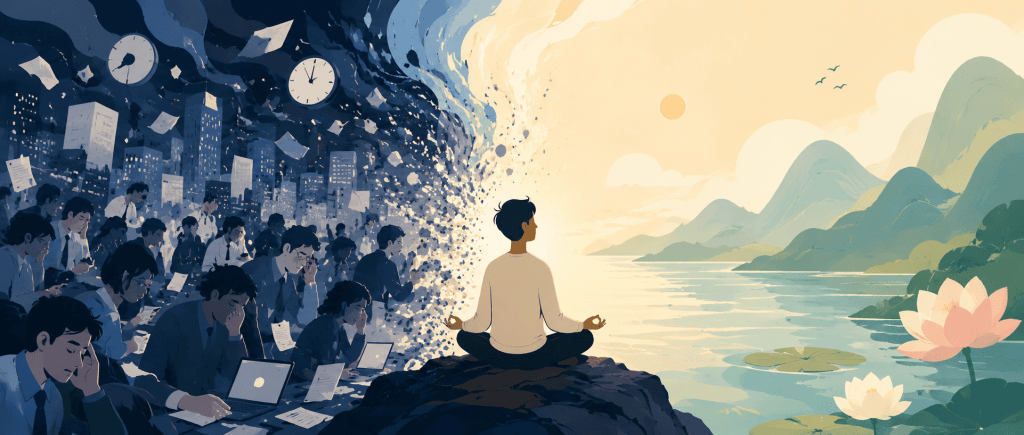
The system we built and why we feel lost?
The modern capitalist system is basically a reflection of human desire. Its main rule is endless growth, which perfectly matches human desire. But strangely, the system we built is now hurting us.
We are forced to work non-stop, feeling anxious, tired, and scared in long run. Inner peace is hard to find. We are no longer treated as humans, but as tiny parts of a machine, slowly becoming numb. We are losing ourselves in our work, our values, and our relationships. So, more and more people began to ask: Where is the meaning of life? Where do all these troubles and pains come from?

In Buddhism, the world we live in is called the “Saha World”, the “World of Endurance.” It naturally has ten basic evils, like lying, greed, anger, and ignorance. People who live here must either endure the pain or seek freedom through spiritual practice.
The dark side of human nature hasn’t changed, but the internet makes it much more obvious. The news we see every day is full of these evils, making the world feel crazy and sad. But the truth is, the world has always been this way. Cruelty and the “survival of the fittest” are its basic rules. One person cannot easily change how it works.
Why do movies about betrayal, murder, and disaster get the most views? Why are violent and fast-paced video games so addictive? Because these strong outside thrills temporarily wake up our numb minds. They give us a quick escape from feeling empty inside.
When a person feels empty, they can’t create their own energy. They have to keep seeking thrills from the outside to fill the hole. It’s like a freezing person who can’t produce their own body heat, only just keep putting on thicker clothes.
“Inner emptiness is the true source of boredom. It makes people constantly seek outside thrills to wake up their spirit and emotions.”
— Arthur Schopenhauer
But outside thrills never last. When the excitement fades, we immediately feel empty again. We have to look for the next, bigger thrill. In this endless cycle, we become numb and completely lose our inner peace.

A Chinese philosophy professor Wang Defeng once said:
“The human heart has no limits. The biggest difference between us and animals is that humans worry. Animals are happy when they are full. But humans are not.”
When we don’t get what we want, we suffer. When we finally get it, we feel bored, thinking, ‘Is this all there is?’”
People either try to prove they are alive by chasing endless desires, or they worry about a future that hasn’t happened yet. Desire and struggle have become what human life is all about.
The drive of life comes from desire. Because we want things, we take action. Before we get what we want, we suffer. This pain can either make us work harder or make us depressed. Those who work hard and achieve their goals feel a quick burst of happiness. But this joy is short. When it fades, boredom takes over. We create a new desire and start suffering all over again.
Just like Schopenhauer said:
“Life swings like a pendulum backward and forward between pain and boredom.”
If you are tired of this endless pain, spiritual practice is the way out. I believe the meaning of life comes down to two things:
- Seeing the cruel world for what it really is: This is what many philosophers try to do.
- Waking up, avoiding the “ten evils,” and finding your inner wisdom to break free from pain: This is what major religions teach us.
We either suffer and let life pass by, or we wake up, see the truth, and stop losing ourselves. This is a choice everyone has to make.
The answer to spiritual pain is inside you
When we have enough money and things, we start to crave spiritual food.
The famous American psychologist Abraham Maslow added a sixth level to his “Hierarchy of Needs”: Self-Transcendence (going beyond the self).
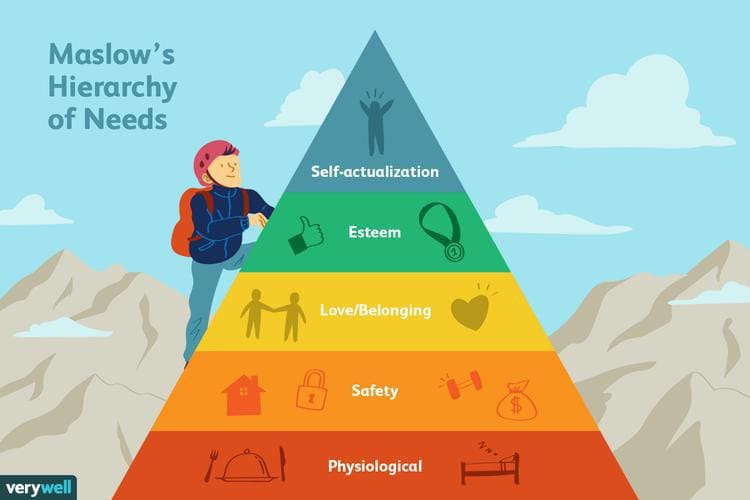
In the past, people just wanted enough food and a safe place to sleep. Today, most people are safe and fed. They spend their time thinking about money, work, and dating. This is what most of society focuses on.
But as we move up Maslow’s pyramid, the higher needs are all spiritual. Only a few people reach the top. They care most about their ideals and spiritual growth, trying to live a fuller life.
That’s why feeling empty and questioning life is so common today. The best way to fix this spiritual pain is never to look outside, but to look inside. You need to build your own inner strength. When your mind is full and strong, you won’t need outside thrills anymore.
Young people today live in a time of both stress and hope. We can’t change the cruelty of the world. But where there is darkness, there is light. We can’t change the world, but we can change ourselves.
If you also feel this pain and want to escape the numbness, it means you still have light inside you. You still want to be your ideal self, but you haven’t found the answer yet. You might be looking everywhere on the outside for the answer to “Who am I?”
The answer is not out there; it is deep inside you.
What does “looking inside” really mean?
“Looking inside” doesn’t mean hiding in your room and ignoring the world. It means you stop caring so much about what others think or buying more things. Instead, you look at your own mind. It is a way of living where you find strength, wisdom, and peace inside yourself.
“Who looks outside, dreams; who looks inside, awakes.”
— Carl Jung
Looking inside is about knowing yourself, accepting yourself, and improving yourself.
Many people try to change by “faking it till they make it”, like pretending to be confident or strong. But this just makes them tired. They feel they are trying hard but nothing changes. This is because your outside behavior is just a reflection of your inside feelings.
Imagine yourself as a tree. Your inner self is the roots; your outer image is the leaves. If you cut off the “bad” leaves, they will just grow back because the roots are the same. If you feel “not good enough” inside, your body will naturally shrink, and your voice will be quiet. Your brain is just following your internal script.
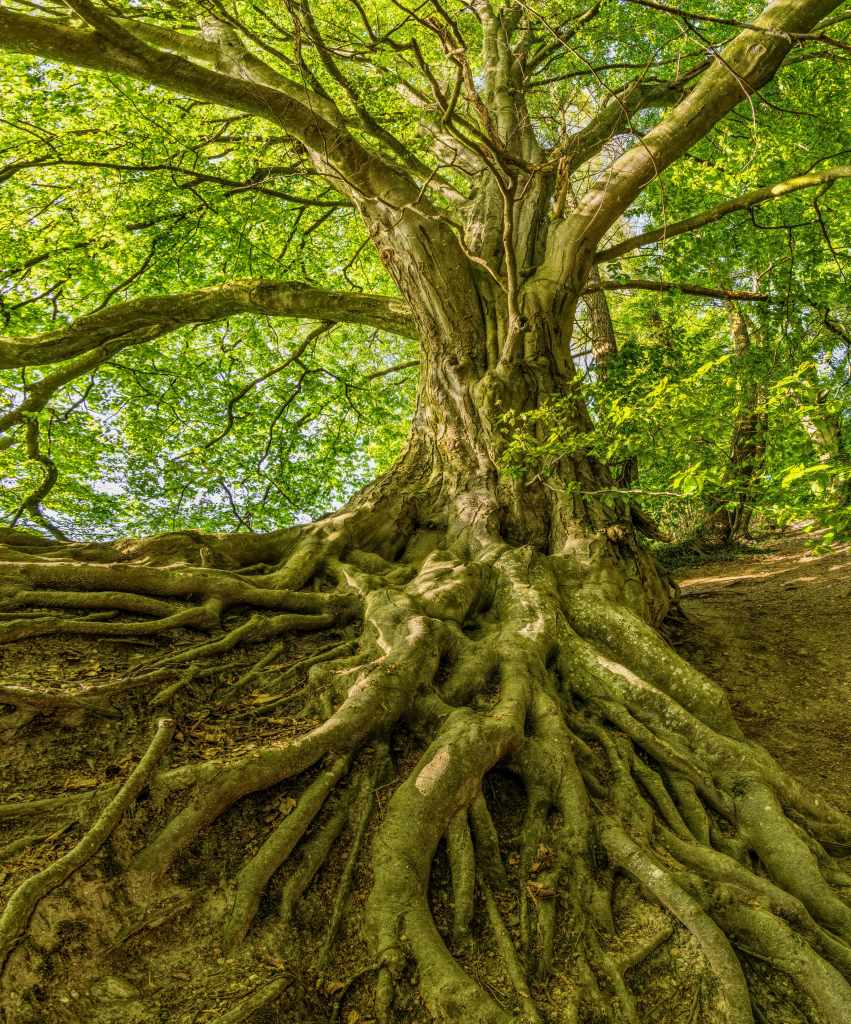
But if you truly accept yourself, your body language and tone of voice will naturally relax. You will look confident without even trying.
True change isn’t about putting on fake armor. It’s about changing how you view yourself deep down. Many say, “This is just my personality; I can’t change.” It’s true that our past and our families shape us deeply. But that doesn’t mean we are stuck. We shouldn’t just trim the leaves; we need to feed the roots. When the roots change, the tree will grow beautiful new leaves.
So, how do we actually do this? Here are the 4 stages.
The four stages of looking Inside
Stage 1: Collision (Learning through others)
Understanding ourselves is the hardest task in life.
“Self is not something visible. You only truly know who you are when you bump into something else and bounce back.”
— Yohji Yamamoto
You have to interact with the world and other people to learn about yourself. You might ask: Isn’t this looking outward? Actually, if you just sit at home and think, you will only create a fake image of yourself.
Going out and looking in work together. When you go out into the world, your beliefs will crash into reality. You might think:
- “Why do the world’s values feel so wrong to me?”
- “Am I really this bad in other people’s eyes?”
This crash causes pain. And that pain forces you to turn inward and really look at yourself.

Stage 2: Realization (Letting go of “truth”)
Later, you realize something huge: The you in other people’s eyes is not the real you.
No one can fully understand you except yourself. If you say one thing, ten different people will feel ten different ways about it. You will realize there is no single “objective truth” in the world, only different perspectives. Even the most perfect person is hated by someone.
Once you realize this, you stop caring so much about what others think. You stop judging yourself with simple words like “good” or “bad.” You start to look at yourself with kindness.
Stage 3: Shifting Mindset (Accepting change)
The third stage is realizing that the “self” is always changing. “I” am not my personality or my past.
British empiricist philosopher David Hume, through introspection, discovered that there is no constant, unchanging “I” or “mind”:
“When I delve very intimately into what I call my ‘self,’ I always encounter this or that particular perception… I can never grasp a ‘self’ without perception.”
Everything changes. Flowers die, people leave, and our feelings change every second. Our pain comes from wanting things to stay the same forever. If you accept that things change, you will feel so much lighter:
- “My current bad situation doesn’t define my whole life.”
- “My current flaws don’t mean I will be like this forever.”
The past is gone. If you hold onto it, you will suffer. The future hasn’t happened yet. Only the present moment is real. We can’t control others, but we can control how we view the world and how we react.
Stage 4: Enlightened (You already have everything)
In the process of personal growth, I discovered that much of Western self-help content focuses on techniques.
- “Five ways to communicate better.”
- “Three steps to become confident.”
The core idea behind many Western methods is “from nothing to something”. It assumes that you lack something, so you must learn a method in order to gain it.
But I later discovered something powerful: Eastern philosophy tells us that we already have everything within us.It is not that these qualities do not exist. It is that they have not yet been fully awakened. This is the meaning of “your true nature is already complete”.
Wang Yangming spoke of “realising innate knowing”. He believed that the human mind is originally like a clear mirror, and that everyone is naturally equipped with wisdom.
Buddhism also teaches that everyone has Buddha-nature. Every person has the potential to awaken.
As the Sixth Patriarch Huineng said:
“How unexpected that the self-nature is originally complete. How unexpected that the self-nature is neither born nor destroyed. How unexpected that the self-nature is originally pure. How unexpected that the self-nature is originally unmoving.”
Although we differ in social status, wealth and background, every person is complete in their true nature. You do not need to search outside for the answer. You do not need to force yourself to become a “better version” of yourself. The person you want to become already exists within you.
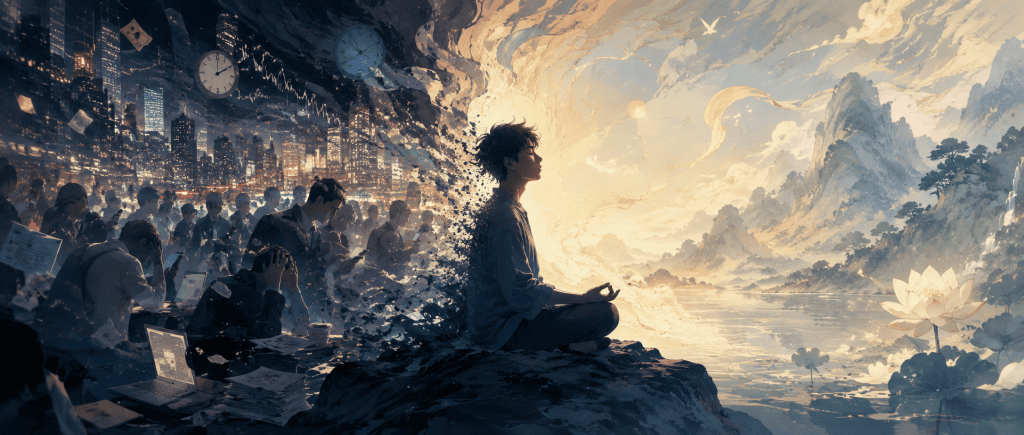
However, social conditioning, negative emotions and attachments are like dust covering a clear mirror.
Because of this dust, we cannot see our true nature clearly. We forget who we are, so we use external labels to define ourselves. We forget our inner ability, so we believe we have nothing. Then we desperately seek outside, but the more we search, the more lost we become.
Daoism speaks of “wu wei”, often translated as non-forcing or effortless action.
It does not mean doing nothing. It means letting go of excessive control and strong utilitarian desire. When we act naturally, we may achieve things more smoothly.
The Tang dynasty monk Shenxiu once wrote:
“The body is a Bodhi tree, The mind is a bright mirror stand. Always polish it diligently, Do not let it gather dust.”
The process of looking inward is the process of wiping dust from the heart. If we combine Eastern and Western philosophy, we may find a path of growth that is especially suitable for modern people:
Use Eastern wisdom as the foundation, and Western methods as tools.
Western methods are practical and often effective in the short term. But without the support of Eastern inner wisdom, they can easily become trapped in utilitarianism.When you use these methods with the Eastern understanding that your true nature is already complete, your mindset changes deeply.
You no longer think: “I hope these methods will give me something I do not have.”Instead, you think: “These methods are tools that help me remove the dust, so that what is already within me can appear.”
For example, if you feel that you are not confident, it may not mean that you have no confidence at all. It may mean that your confidence is covered by dust.The methods for building confidence are not meant to inject confidence into you from the outside. They are meant to help you remove the obstacles so that the confidence already within you can show itself.
So the Eastern path of growth is a process of: Already having →Being covered,
→And becoming visible again.
You can tell yourself:
- You are already good enough.
- You already have the possibility to become the person you want to be.
- You already have the strength within you.
Listen to your inner peace
In this crazy time, we can’t change the world. But we can look inside. This stops us from being twisted by the system and losing ourselves.
Looking inward is not running away from reality; it is preparing to face it better. When you stop needing outside praise, stop chasing endless desires, and stop holding onto the past, you will find something amazing: True peace never comes from the outside. It grows from inside you.



Leave a Reply